

Who Is Michael Simmons?
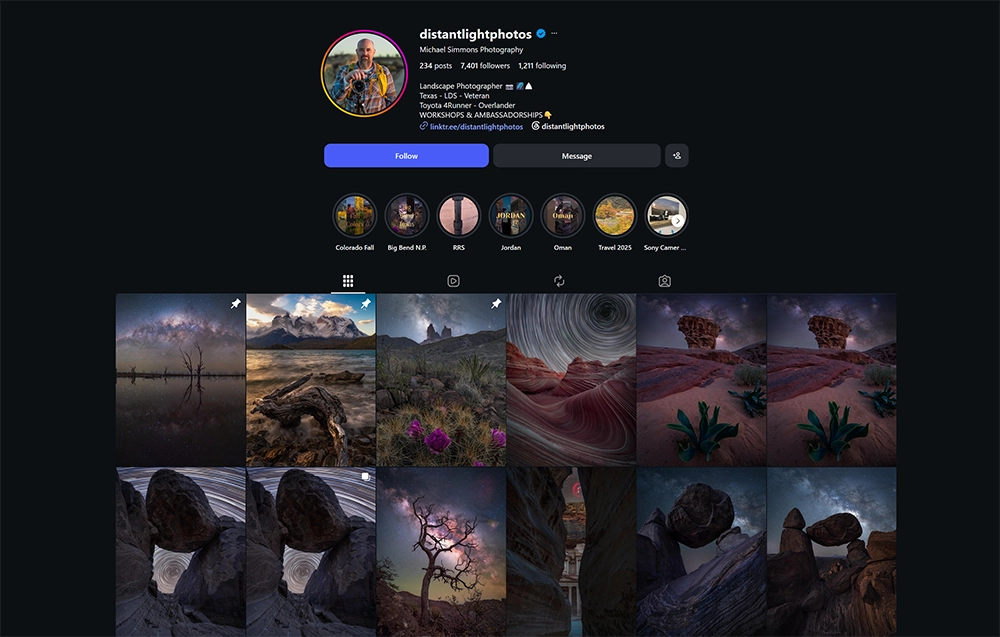
Michael Simmons is a Texas-based landscape and astrophotography photographer whose work is built around distance, darkness, silence, and the slow drama of natural light.
Through @distantlightphotos, he explores wild places with a patient eye, often turning deserts, mountains, canyon walls, night skies, and remote landscapes into images that feel both cinematic and quiet. His photography does not chase the loudest version of nature. It often seems more interested in the moment just before the spectacle becomes obvious, when the sky is still breathing, the land is holding its shape, and the light has not yet decided whether to disappear or stay.
His work moves between landscape photography, astrophotography, overlanding, travel, and visual storytelling. The result is a body of images shaped by movement, but not by haste. Michael’s photographs often carry the feeling of someone who has spent time with a place rather than simply passing through it for a picture.
As a veteran, adventurer, workshop host, and fine art photographer, Michael’s creative identity sits at the intersection of discipline and wonder. His images show a clear respect for place, weather, timing, and the patience required to photograph remote landscapes well. The camera does not feel like a tourist tool in his hands. It feels more like a way of listening.
What defines his work most is atmosphere. Night skies feel heavy. Horizons feel distant. Rocks, sand, stars, and shadows are not treated as decoration, but as parts of a larger visual conversation between earth and sky. Michael creates photography for people who still believe silence can hold power, and that sometimes the most memorable light is the one found far away from everything else.
The Review. Composition And Framing
Composition is where Michael shows real intention. The stronger images appear to understand scale, foreground weight, and the emotional usefulness of distance. A canyon wall is not just a wall, it becomes a border. A tree is not just a tree, it becomes a witness. A dune is not just a dune, it becomes a line that keeps walking after the viewer has stopped.
Michael seems especially comfortable with vertical drama. Night skies, rock formations, solitary natural subjects, and long geological shapes all benefit from this approach. The frame often asks the viewer to travel through it slowly, from earth to sky, from foreground to horizon, from detail to vastness.
There is also a clear preference for the heroic landscape frame. That is not automatically a problem. Landscape photography has always had a relationship with awe. But awe is a dangerous tool. Use too much of it, and every image starts speaking in the same deep movie-trailer voice. The best posts avoid that by giving the eye a place to rest: a lone tree, a curve in the sand, a quiet ridge, a small human trace, a rock formation that interrupts the huge sky.
Michael would become even stronger if he occasionally trusted smaller compositions. Not every image needs to open the heavens. A tighter study of stone, dust, bark, dry grass, or reflected light could deepen the visual rhythm and give the grand scenes more contrast.
Negative Space
Negative space is one of Michael’s quiet weapons. The sky often functions not just as background, but as emotional architecture. In astrophotography, this can become powerful. A dark sky filled with stars naturally creates scale, but when handled well, it also creates humility.
The feed appears to understand that emptiness is not absence. Desert space, night space, sky space, distance between objects, these all help the work breathe. This matters because Instagram is usually allergic to breathing. The platform wants compression, faces, movement, explainers, hooks, noise. Michael often chooses the opposite. That restraint gives Michael maturity.
Still, some images could push this further. Negative space works best when it feels deliberate, not leftover. The most memorable frames are likely the ones where emptiness has shape, where the open sky or desert floor is doing compositional labor. When the empty areas simply sit there, the image becomes pretty rather than necessary.
Lighting
Michael is, unsurprisingly, obsessed with light. The name ‘distantlightphotos’ already gives that away. But the interesting part is not just that the work chases beautiful light. It is that the light often arrives as a character.
Blue hour, starlight, Milky Way glow, distant horizon color, desert dusk, reflected night tones, these are not decorative elements. They are the emotional engine of the work. The better images seem to understand that landscape photography is less about showing a place and more about showing what the place becomes under a specific kind of light.
Astrophotography is where this feels most obvious. Long exposures and night-sky work can easily become technical demonstrations, the photographic equivalent of saying, “Look what my camera can do.” Here, the stronger images seem more interested in mood than in gear flexing. That is important. Technique should serve wonder, not replace it.
The risk is that dramatic light can become a shortcut. A Milky Way over a landscape will almost always stop the scroll. The deeper challenge is making it recognizable as this photographer’s Milky Way, this photographer’s landscape, this photographer’s way of seeing. Michael is close to that, but the more it sharpens its visual signature beyond the obvious spectacle, the more durable it becomes.
Colors
The color language appears rooted in the natural extremes of landscape photography: deep blues, night purples, dusty oranges, golds, cool shadows, pale desert tones, and the luminous gradients of late or early light. The palette is attractive, and more importantly, coherent.
This is not a feed that seems confused about its world. It knows where it wants to live. It lives between earth and sky, between warm terrain and cool atmosphere, between the physical and the cosmic.
The color work is strongest when it lets darkness stay dark. That sounds simple, but many landscape accounts flatten night into neon wallpaper. Here, the better images appear to preserve a sense of depth. Shadows still have weight. Night still feels like night. That gives the work a more serious tone.
A possible improvement would be more restraint in the most dramatic edits. The contemporary landscape space is crowded with hyper-polished skies and almost supernatural color transitions. Michael should be careful not to let natural wonder slide into visual overstatement. The most convincing images are usually the ones that look enchanted, not inflated.
Symmetry And Patterns
Patterns appear in the geological subjects: dunes, canyon walls, rock textures, tree forms, mountain ridges, star fields, and repeating desert lines. This is one of the more interesting parts of Michael because pattern gives the work structure. It stops the images from becoming only “beautiful place, beautiful sky.”
Symmetry is not always literal here. It is more often a balance of forces. Earth below, sky above. Dark mass against glowing air. A small subject against an enormous background. Lines moving toward the center, stars spreading outward, rock forms holding the lower frame in place.
Michael could benefit from making this pattern language even more central. The most memorable landscape photographers do not only photograph places, they photograph relationships: line against line, silence against movement, texture against emptiness. Michael already has the raw material for that. The next step is to make the visual grammar unmistakable.
Textures
Texture is where Michael has room to become more intimate. The landscapes offer plenty of surface: sand, stone, bark, dust, water, cloud, rock, scrub, canyon walls, and night air. In the available work, texture often supports the wider scene rather than becoming the subject itself. That is understandable. This is a big-view account. It likes scale. It likes distance. It likes the feeling of standing before something larger than yourself.
Engagement Quality
But texture could give the work more body. Close studies of terrain, small details from the journey, or quieter frames between the spectacular scenes would make the feed feel less like a gallery of destinations and more like a lived experience. Michael already suggests adventure and overlanding through its public profile and link hub. More tactile, grounded images could make that journey feel even more personal.
This is where Michael performs better than the raw numbers might suggest. The engagement is not explosive, but it feels real. The comment sections show photographers and viewers responding to specific elements in the work: the twisting shape of a tree, the strength of the star trails, the atmosphere of Arabia, the beauty of the feed, the feeling of place. That is already more meaningful than a wall of empty emojis.
What stands out most is that Michael replies. Not with cold copy-paste responses, but with friendly, direct, personal answers. He thanks people by name, adds context, shares small details about the image, and turns praise into conversation. In one exchange, he explains that a tree is by far his favorite he has photographed, and that the star trails made it even better. That small sentence does a lot. It gives the image memory. It turns a post from “beautiful shot” into “this subject matters to him.”
The audience also includes other photographers, which raises the quality of the interaction. Comments from people who understand light, location, patience, and timing carry a different kind of weight. The replies are not all deep essays, but they show warmth, recognition, and peer respect. That gives the account a stronger community signal than likes alone could show.
The weakness is that the comment depth still varies. Some responses are short, some are emoji-based, and not every post will create a long discussion. But for a landscape and astrophotography account, this kind of engagement is healthy. People are not just passing through. They are reacting to the work, naming what they see, and returning the energy Michael gives back.
Let’s Wrap This Up
This is a beautiful account with a calm pulse. It does not scream for attention, which is refreshing. The work has a real eye for scale, sky, solitude, and atmosphere. My opinion: the strongest images are the ones where the landscape feels less like a destination and more like a state of mind. When Michael trusts silence, it becomes far more powerful than when it chases spectacle.
Should You Follow Michael Simmons?
Yes, especially if you like landscape photography that takes its time. Follow Michael if you are drawn to deserts, dark skies, distant horizons, and images that feel more like standing still than scrolling fast. This is not the account for someone looking for daily personality chaos or algorithm-friendly visual candy. It is for people who still believe a photograph can make silence visible.
Brave enough for the truth? Submit your handle, we’ll tell you what’s fire and what needs polish.
Is Astrophotography still magical to you, or has Instagram made too many night skies look the same? Comment 👇