

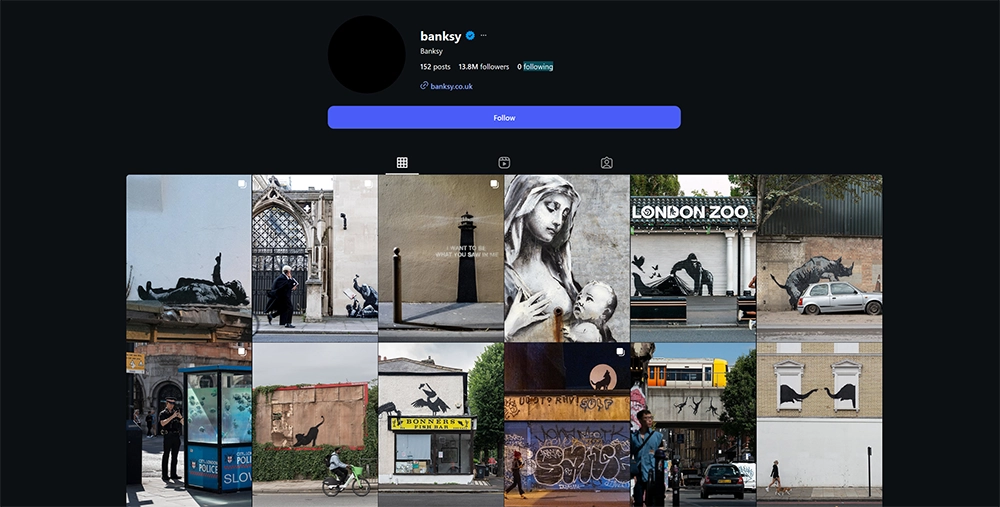
Let’s get the awkward part out of the way. BANKSY is not just an artist, he is a brand, a myth, a global operating system for rebellion. He doesn’t need Instagram. Instagram needs him. Which makes his Instagram feed fascinating for all the wrong reasons.
Banksy’s account is not about discovery, risk, or visual experimentation. It is documentation. Proof of authorship. A timestamped receipt saying “yes, this one’s mine”. It exists to prevent forgery, guide auctions, calm lawyers, and quietly steer a billion-dollar secondary market.
As art, the works still hit. As an Instagram feed, it is colder than a museum archive. The irony is thick enough to stencil.
Listen As You Read On
The Feed at a Glance
You scroll. A new mural appears. One image, sometimes two. No hashtags. No captions beyond location. No engagement farming. No explanation. No comments from Banksy. Silence. This is intentional. And that intention is both the feed’s strength and its creative dead end.
Scrolling this feed isn’t rebellion, it’s paperwork.
This is street art after a hostile takeover by a notary. Everything disinfected, centered, bordered, and presented like forensic evidence. White margins everywhere, like the work is afraid of touching the screen. You’re not wandering an alley, you’re standing in a climate-controlled archive where spontaneity went to die.
The grit survives, barely, but it’s been put on a leash. Every image keeps you at arm’s length. Observe. Do not interact. Do not feel too much. This isn’t art asking for a reaction, it’s art demanding compliance. Look. Acknowledge. Move on.
And yes, that distance is deliberate. This feed hates the app it lives in. No captions to hold your hand. No context. No warmth. No fun. It’s an aggressive refusal to participate, which would be noble if it didn’t look so damn institutional. Anti-algorithm aesthetics have become their own algorithm, and this account follows it religiously.
The real function here isn’t artistic, it’s bureaucratic.
This is the central registry. The blockchain of spray paint. In an era drowning in AI sludge, knockoff stencils, and “Banksy-coded” Etsy trash, this feed is the only authority that matters. If it’s not posted here, it’s fan fiction. A wall can get hit in Ukraine, Wales, or behind your local Tesco, but until this account uploads the JPEG, it might as well not exist.
So the ritual begins. The work appears in the real world, raw and exposed. And then everyone waits. Journalists. Collectors. Auction houses. Instagram addicts with opinions. Refresh. Refresh. Refresh. Waiting for the official ghost stamp.
And when it finally drops, the physical act is retroactively legitimized. The paint didn’t make it real. The post did.
That’s the bleak comedy of it. Street art, born as an act of defiance, now standing patiently in line for verification inside an app built to monetize attention and sell self-help masculinity. The wall is just the draft. The feed is the final version. Rebellion, but make it clerical.
Ultimately, the writing on this digital wall is clear. It tells us that art is still a weapon, that anonymity is a form of power, and that even in an age of total surveillance, there are things that cannot be fully captured. The account is a masterclass in branding through absence. By giving us so little of himself, the artist gives us everything we need to focus on the world around us. It is a haunting, beautiful, and occasionally hilarious record of our times, pinned to a digital board for us to contemplate before the next scroll takes us elsewhere.
Visual Analysis
Composition & Framing
Banksy’s compositions are ruthlessly efficient. Subjects are centered or deliberately offset, negative space is used as a weapon, not decoration. Walls become stages. Urban decay becomes texture.
On Instagram, however, the framing often feels utilitarian. The shots are rarely optimized for the square or vertical format. Cropping feels like an afterthought. The image exists to prove the work exists, not to seduce the viewer.
Negative Space
This is where Banksy still schools everyone. Empty wall equals silence. Silence equals tension. The void around the stencil amplifies the message. On feed, the negative space reads well, but it also flattens quickly when every post follows the same visual logic.
Symmetry & Patterns
Symmetry is rare. Balance is emotional, not mathematical. Patterns emerge conceptually, not visually. Repeated themes, rats, children, authority figures, weapons, surveillance. Visually compelling, predictably Banksy.
Lighting
Available light only. No drama. No cinematic ambition. Shadows exist because the sun exists (🤣). It’s honest, but it’s also visually conservative for a feed consumed on glowing rectangles.
Colors
Mostly muted. Grays, concrete, rust, off-white walls. When color appears, red especially, it’s symbolic, not aesthetic. Instagram thrives on color. Banksy refuses to play that game, which is admirable and visually monotonous.
The Real Problem
Banksy’s Instagram is anti-Instagram by design. That’s the joke. But jokes get old when repeated without variation. The feed has no arc, no rhythm, no visual evolution. Ten years ago this felt radical. Today it feels static. The rebellion calcified into protocol. And here’s the uncomfortable truth: the mystery no longer lives here. The work is still sharp. The delivery is not.
My Opinion
In my view, Banksy’s work remains the most vital pulse in contemporary art. While some critics argue he has become “TOO COMMERCIAL,” his ability to use the tools of the modern age to critique that very age is unparalleled. His Instagram is the perfect manifestation of this, it is a Trojan horse in our pockets, bringing uncomfortable truths into our daily routines under the guise of “content.”
Hit Follow, or Move On?
Yes, but not for inspiration. Follow to stay informed. Follow to see what the machine approves. Follow to understand how myth sustains itself long after the shock wears off. If you’re looking for creative energy, experimentation, or visual risk, this isn’t the place anymore.
In the End, Here’s What Stands
Banksy’s Instagram is powerful, sterile, and slightly disappointing. The art still matters. The feed doesn’t try to matter. And while that refusal once felt punk, it now reads like institutional confidence. This is not an artist fighting the system. This is an artist managing it. Ironically, the most radical thing Banksy could do on Instagram today would be to actually care about Instagram.
Note: The Banksy review positions RateMyInsta as a platform that doesn’t just judge images, but dismantles myths, dissects platform behavior, exposes cultural contradictions, and proves it can critique even untouchable icons with authority and bite. We’re not limited by genre.
Feed looking tired? We’ve got the caffeine. Submit your handle for a much-needed creative wake-up call.